
Introduction: Understanding the Scoliosis-Hip Pain Connection
If you’ve been diagnosed with scoliosis and are experiencing nagging hip pain, you’re not alone. Many Dallas-area patients are surprised to learn that their hip discomfort may stem from their spinal curvature rather than a problem with the hip joint itself. The connection between can scoliosis cause hip pain isn’t always immediately obvious, which can lead to frustration, misdiagnosis, and ineffective treatment approaches.
Hip pain. Understanding this relationship is crucial for anyone living with scoliosis, as it opens the door to more targeted and effective treatment strategies. At Legent Spine, our board-certified spine surgeons specialize in diagnosing the root causes of complex pain patterns and developing personalized treatment plans that address the underlying biomechanical issues. For more information, see our page on understanding scoliosis hip pain causes symptoms.
The good news? Once properly diagnosed, scoliosis-related hip pain often responds well to conservative treatment approaches. For more complex cases, advanced minimally invasive techniques offer excellent outcomes with faster recovery times. If you’re experiencing unexplained hip pain alongside your scoliosis diagnosis, a comprehensive evaluation from a spine specialist can provide the clarity and relief you’ve been seeking.
What Is Scoliosis and How Does It Develop?
Scoliosis is an abnormal sideways curvature of the spine that creates a C-shaped or S-shaped curve when viewed from behind. Unlike the natural forward and backward curves that provide spinal stability and shock absorption, scoliotic curves twist laterally and can rotate the vertebrae, creating three-dimensional spinal deformity.
The condition develops through several pathways. Understanding scoliosis hip pain causes symptoms requires recognizing these different types. Idiopathic scoliosis—meaning the cause is unknown—accounts for approximately 80% of cases, particularly adolescent idiopathic scoliosis. Congenital scoliosis occurs when spinal abnormalities develop before birth, while neuromuscular scoliosis results from conditions like cerebral palsy or muscular dystrophy that affect muscle control and balance.
The severity of scoliosis is measured in degrees using the Cobb angle method. Medical professionals classify curves as mild when measuring, moderate between, and severe above 40 degrees. This classification system helps spine specialists determine appropriate treatment approaches and predict the likelihood of progression.
Scoliosis can develop during childhood, adolescence, or adulthood. Adolescent cases often emerge during growth spurts, while adult scoliosis may represent progression of an adolescent curve or degenerative changes that develop later in life. Regardless of when it develops, the biomechanical consequences can affect structures throughout the body—including the hips.
The Biomechanical Link: How Scoliosis Affects Hip Function
The relationship between scoliosis causes hip painand dallas patients is rooted in fundamental biomechanics. Your spine serves as the central support structure for your entire body, and when it curves abnormally, the effects cascade downward through the pelvis and into the hips.
Understanding this connection requires recognizing how your body compensates for spinal imbalance. When scoliosis develops, your brain automatically adjusts muscle activation patterns and weight distribution to maintain upright posture and balance. These compensatory mechanisms, while initially helpful, create chronic strain on muscles, joints, and soft tissues throughout the lower body.
This altered alignment forces the hip joints to function in mechanically disadvantaged positions, accelerating wear and tear while creating abnormal stress concentrations.
The muscular consequences are equally significant. Over time, this chronic overwork creates a cycle of muscle tension, inflammation, and discomfort that many patients experience as persistent hip pain.
Uneven Weight Distribution
A curved spine shifts your body’s center of gravity laterally, moving it away from the midline. This shift forces one hip to bear significantly more load than the other during standing, walking, and other weight-bearing activities. The overloaded hip experiences greater compressive forces on the joint cartilage and increased tension in surrounding muscles and ligaments.
This chronic stress creates a biomechanical environment where degenerative changes accelerate. The hip bearing less weight may develop weakness and instability, while the overloaded side faces increased risk of osteoarthritis, labral tears, and bursitis.
Pelvic Misalignment
The pelvis doesn’t remain neutral when scoliosis develops. Instead, it rotates and tilts to accommodate the spinal curve above it. This pelvic adaptation creates asymmetrical function in the hip flexors, extensors, abductors, and rotators. One hip may be positioned in relative flexion while the other extends, creating different movement patterns and stress distributions on each side.
Sacroiliac joint dysfunction commonly develops alongside scoliosis. This SI joint pain can be difficult to distinguish from hip pain, as the discomfort often radiates into similar areas. For more information, see our page on scoliosis and hip pain 7.
The asymmetrical muscle work required to stabilize a misaligned pelvis creates chronic tension patterns. Hip flexors on one side may become perpetually tight while the opposite side weakens, setting up muscular imbalances that perpetuate pain and dysfunction.
Common Scoliosis Symptoms Beyond Back Pain
While back pain is the most recognized symptom of scoliosis, the condition creates a constellation of symptoms that extend well beyond the spine itself. Many Dallas patients are initially unaware that seemingly unrelated symptoms may trace back to their spinal curvature. For more information, see our page on scoliosis causes hip painand dallas patients.
Hip and leg pain represent common but underrecognized manifestations of scoliosis. Patients often describe deep, aching discomfort in one hip that intensifies throughout the day and improves somewhat with rest.
Visible asymmetry is another hallmark of scoliosis. Uneven shoulders, with one appearing higher than the other, are often the first sign parents notice in adolescents. The waistline may appear asymmetrical, with more pronounced curves on one side. In more pronounced cases, one shoulder blade may protrude more prominently, creating what’s called a rib hump when the person bends forward.
Breathing difficulties can develop with severe thoracic curves that restrict chest wall expansion. The curved spine may reduce lung capacity, causing shortness of breath during exertion or when lying flat.
Neurological symptoms warrant immediate attention. Tingling, weakness, or changes in bowel or bladder function suggest nerve compression that may require prompt intervention to prevent permanent damage.
When Hip Pain Is Caused by Scoliosis: Key Signs
Distinguishing scoliosis-related hip pain from other hip conditions requires attention to specific patterns and characteristics. Several key signs suggest your hip pain stems from spinal curvature rather than a primary hip disorder.
Postural sensitivity is a revealing indicator. If your hip pain significantly worsens with certain postures—particularly standing for extended periods or sitting in unsupported positions—and improves when you change position or lie down, scoliosis may be the culprit. Primary hip joint problems typically cause pain with specific movements rather than sustained postures. For more information, see our page on can scoliosis cause hip pain 2.
Asymmetrical pain distribution is another important clue. If your right hip hurts and your spine curves prominently to the right, the biomechanical connection becomes clearer.
Radiation patterns matter. Scoliosis-related hip pain often seems to radiate downward from the lower back toward the hip and outer thigh, following the path of stressed muscles and altered loading patterns. In contrast, pain from hip joint pathology tends to localize more specifically to the groin, outer hip, or buttock.
The gradual onset of symptoms is typical of scoliosis-related hip pain. Rather than resulting from a specific injury or event, the discomfort develops slowly over months or years as compensatory mechanisms become increasingly strained. Sudden, acute hip pain following an injury is less likely to be primarily scoliosis-related.
This response to conservative treatment can help confirm the diagnosis, though a comprehensive evaluation remains essential for certainty.
Diagnosis: How Spine Specialists Evaluate Scoliosis and Hip Pain
Accurate diagnosis requires a systematic approach that correlates clinical findings with imaging studies. At Legent Spine, our board-certified spine surgeons begin with a thorough medical history, exploring the timeline of your symptoms, aggravating and relieving factors, and any previous treatments you’ve tried.
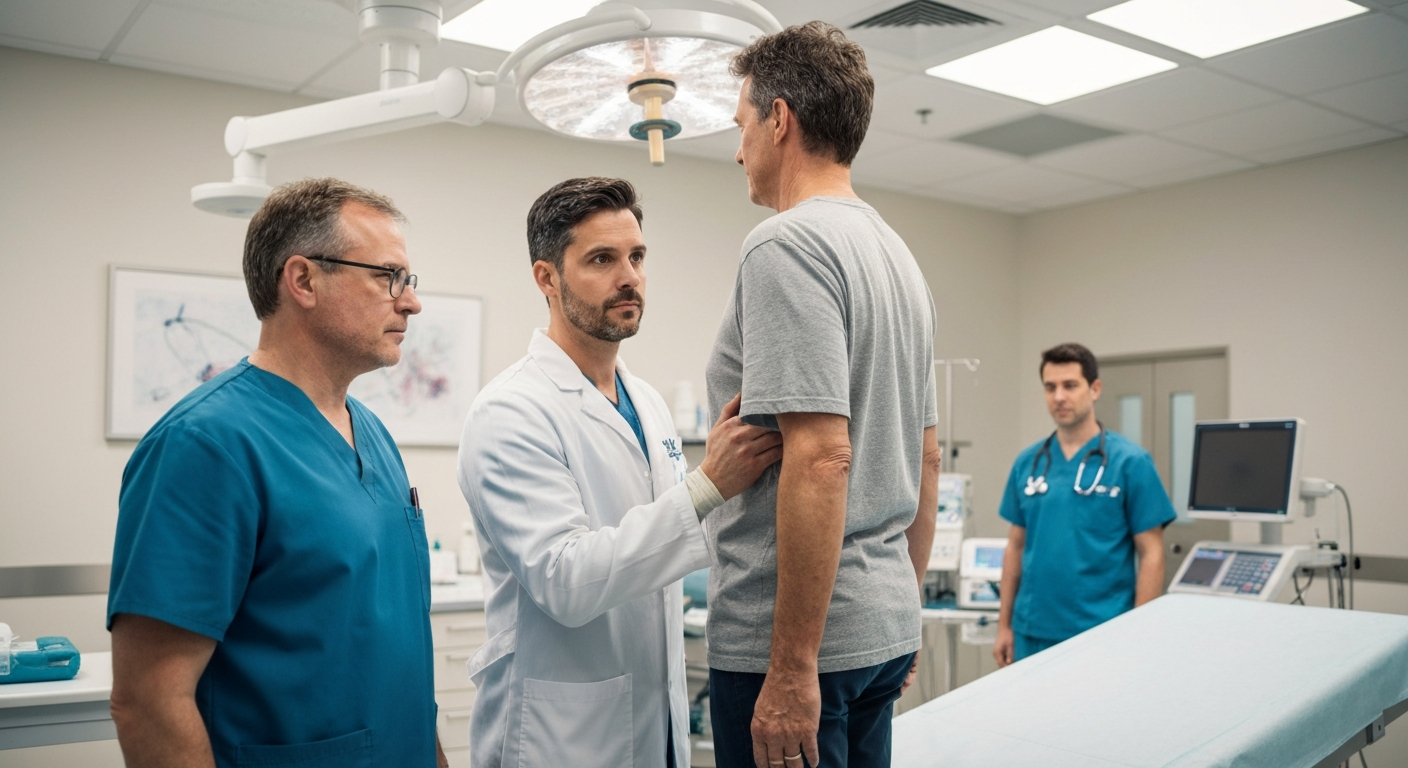
The physical examination provides crucial information. Your spine specialist will observe your posture, spinal alignment, and pelvic positioning while standing. You’ll be asked to bend forward, which makes scoliotic curves more visible and may reveal rotational deformities. Hip range of motion testing, muscle strength assessment, and palpation of tender areas help distinguish spinal issues from primary hip pathology.
Standing full-spine X-rays show the entire spinal alignment and allow precise measurement of curve severity using the Cobb angle. These images also reveal pelvic alignment and can demonstrate leg length discrepancies that may contribute to symptoms.
Advanced imaging may be necessary for complex cases. MRI scans provide detailed views of soft tissues, including intervertebral discs, spinal nerves, and surrounding muscles. CT scans offer exceptional bone detail and may be used for surgical planning when intervention becomes necessary.
Neurological testing ensures no nerve compression is present. Your spine specialist will test reflexes, sensation, and muscle strength in your legs to identify any neurological deficits requiring urgent attention.
This differential diagnosis is critical, as treatment approaches differ significantly depending on the underlying cause.
Treatment Options for Scoliosis-Related Hip Pain
The treatment approach for scoliosis-related hip pain typically begins with conservative management, as many patients achieve significant relief without surgical intervention. The goal is to address the biomechanical imbalances driving your symptoms while improving your overall function and quality of life.
A structured therapy program targets the specific muscular imbalances created by your scoliotic curve, strengthening weak areas while releasing chronically tight muscles.
Anti-inflammatory medications help manage pain and reduce inflammation in stressed tissues. While not addressing the underlying cause, these medications can provide relief that allows you to participate more fully in physical therapy and maintain your daily activities.
Postural modifications and ergonomic adjustments reduce the daily stress on your spine and hips. Your care team may recommend specific seating supports, sleeping positions, or activity modifications that minimize symptom aggravation.
When conservative approaches don’t provide adequate relief, or when curves are severe and progressing, surgical intervention may be appropriate. The spine specialists at Legent Spine offer advanced minimally invasive options that can correct spinal alignment while minimizing tissue disruption and recovery time.
Conservative Approaches
Structured physical therapy programs form the foundation of conservative treatment. Your therapist will design exercises that strengthen core stabilizers, improve flexibility in tight muscle groups, and enhance overall spinal stability. These programs typically include targeted strengthening, stretching, and functional movement training tailored to your specific curve pattern and symptoms.
Bracing may be recommended for adolescent patients with curves between certain degree ranges to prevent progression during remaining growth. While bracing doesn’t correct existing curves in adolescents, it can successfully halt progression in many cases.
Activity modification doesn’t mean giving up the activities you love. Instead, it involves learning how to perform movements in ways that minimize stress on compromised structures. Your care team can provide guidance on safe exercise techniques and suggest modifications for work and recreational activities.
When Surgery May Be Necessary
Surgical intervention becomes appropriate when conservative treatment fails to provide adequate symptom relief, when curves are progressing rapidly, or when neurological symptoms develop.
Modern surgical approaches focus on correcting spinal alignment while preserving as much normal motion and function as possible. The specific procedure depends on curve location, severity, and your individual anatomy and goals.
At Legent Spine, our surgeons have extensive experience with advanced techniques that minimize disruption to surrounding tissues while achieving excellent corrective outcomes.
The decision to pursue surgery is always made collaboratively between you and your spine surgeon, considering your symptoms, lifestyle, goals, and overall health status. Our team ensures you have complete information about potential benefits, risks, and expected outcomes before proceeding.
Expert Spine Care in the Dallas Area
Residents throughout the Greater Dallas area have access to world-class spine care at Legent Spine. Our board-certified, fellowship-trained spine surgeons bring years of specialized experience to every patient evaluation, combining advanced diagnostic capabilities with a commitment to conservative-first treatment approaches.
We understand that scoliosis-related hip pain affects every aspect of your life—from work productivity to recreational activities to simple daily tasks. That’s why we take time to thoroughly understand your specific symptoms, concerns, and goals before recommending any treatment path.
Our comprehensive evaluation process ensures accurate diagnosis and appropriate treatment planning. We utilize state-of-the-art imaging technology and conduct thorough physical examinations to identify the precise source of your symptoms and develop personalized treatment strategies that address your unique situation.
When minimally invasive surgical intervention becomes appropriate, our surgeons offer advanced techniques that reduce tissue trauma, minimize blood loss, and shorten recovery times. Every patient benefits from dedicated care coordination throughout their treatment journey, ensuring seamless communication and support from initial consultation through full recovery.
Conclusion: Getting Answers About Your Hip Pain
Scoliosis can absolutely cause hip pain through the biomechanical changes it creates in your spine, pelvis, and lower extremities. The altered weight distribution, pelvic misalignment, and compensatory muscle patterns that develop with scoliotic curves place significant stress on hip structures, leading to the pain and dysfunction many patients experience.
Understanding this connection is the first step toward effective treatment. Rather than treating your hip and spine as separate problems, a comprehensive approach addresses the underlying biomechanical issues driving your symptoms. This integrated perspective often leads to better outcomes and more lasting relief.
The range of treatment options—from targeted physical therapy and postural modifications to advanced minimally invasive surgical techniques—means that effective solutions exist for patients at all points along the severity spectrum. Early intervention often prevents symptom progression and may help you avoid more invasive treatments down the road.
If you’re experiencing hip pain alongside a scoliosis diagnosis, you deserve answers and expert care. The spine specialists at Legent Spine are here to provide the comprehensive evaluation, accurate diagnosis, and personalized treatment planning you need to reclaim your quality of life. We invite you to schedule a consultation to discuss your symptoms and explore your treatment options.