
Understanding Your Spondylolisthesis Diagnosis
If you just saw the words “Grade II” on an imaging report, you probably have questions. usually A spondylolisthesis grade describes how far one vertebra has slipped forward over the vertebra below it. Spondylolisthesis itself is a condition in which.
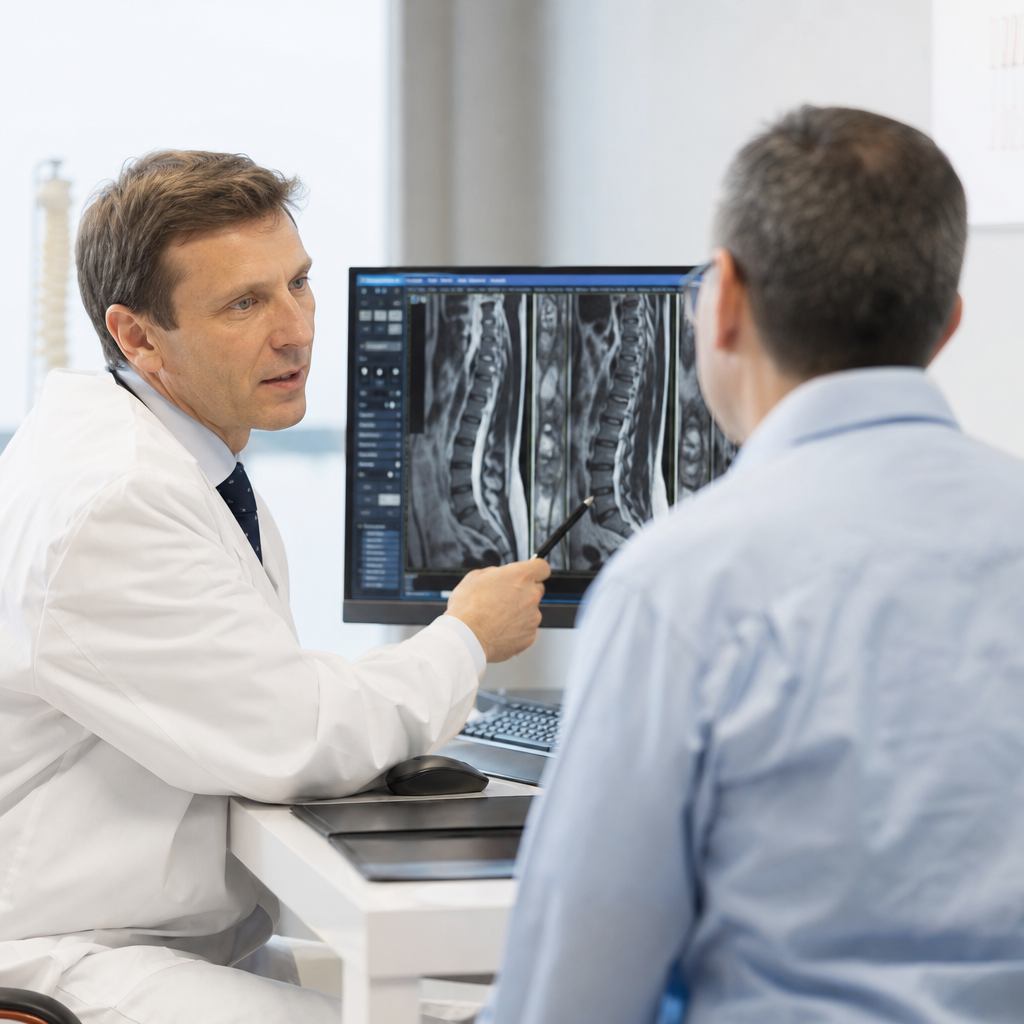
The good news is that most low-grade slips are managed without surgery. This article explains the grading scale, common symptoms, and treatment paths. For a broader overview, you can also read our guide to spondylolisthesis grades and treatment.
If you have questions about your imaging, readers in Fort Worth and Greater Dallas are welcome to schedule a comprehensive evaluation with a board-certified spine specialist at Legent Spine.
What Is Spondylolisthesis and Why Does Grading Matter?
Spondylolisthesis happens when a vertebra slides out of its normal alignment. It most often affects the lower back, where the spine carries the most load.
There are four common types:
- Isthmic: a defect or stress fracture in the pars interarticularis, a small bridge of bone in the vertebra
- Degenerative: age-related wear in the discs and facet joints, most often at the L4-L5 level in older adults
- Congenital: a spine that formed differently before birth
- Traumatic: a slip that follows an acute injury. You can learn more in our resource on patients traumatic spondylolisthesis treatment options.
Isthmic slips most often occur at the L5-S1 level.
Your grade, symptoms, and spinal stability together guide your treatment plan. The grade alone does not decide whether you need surgery.
The Meyerding Classification: Grades I Through V
The Meyerding classification is the most widely used grading system. It divides spondylolisthesis into five grades based on how much of the vertebral body has slipped forward. Harry Meyerding introduced it.
Doctors measure the slip as a percentage of the vertebral body width on a lateral (side-view) X-ray:
- Grade I: up to 25 percent slippage
- Grade II: 25 to 50 percent
- Grade III: 50 to 75 percent
- Grade IV: 75 to 100 percent
- Grade V: more than 100 percent, also called spondyloptosis, in which the vertebra has slipped completely off the one below it
Grading is typically done on standing lateral X-rays, because the weight of your body can show the true degree of slippage. Flexion-extension films, taken as you bend forward and backward, can reveal whether the segment is unstable.
Low-Grade Slips (Grades I and II)
Many people with a Grade I or II slip have mild symptoms or none at all. When symptoms do appear, they often include:
- Low back pain
- Hamstring tightness
- Leg pain when standing or walking
Nonsurgical care is usually the first step. Most patients with low-grade spondylolisthesis improve with. For additional background, see this resource on aaos spondylolisthesis nonsurgical treatment 5.
Your surgeon may consider surgery if symptoms persist despite conservative care or if a nerve is being compressed.
High-Grade Slips (Grades III, IV, and V)
Higher-grade slips are more complex. They are more likely to cause nerve compression, changes in posture, and problems with walking. They are also more common in younger patients with isthmic or congenital types.
High-grade spondylolisthesis is more likely than low-grade slippage to require. These cases deserve a careful evaluation by an experienced spine specialist.
often Severe slippage can compress the cauda equina, the bundle of nerves at the base of the spinal canal. This can cause bowel or bladder dysfunction, which needs prompt medical attention.
At Legent Spine, we aim for a transparent, personalized discussion of the risks and benefits of every option. That way, you can make a decision that fits your life.
Other Factors Beyond the Grade
A complete assessment looks beyond the percentage of slippage. Your spine specialist will also consider:
- Slip type: the Wiltse-Newman classification categorizes slips as, and the type affects your outlook.
- Stability: whether the segment moves abnormally or the slip progresses over time.
- Nerve compression: MRI can show nerve compression and disc changes that.
- Your personal health: your age, activity level, and overall health.
Symptoms and How Spondylolisthesis Is Diagnosed
Common symptoms include:
- Low back pain
- Thigh or leg pain
- Numbness or tingling
- Muscle tightness, especially in the hamstrings
- Trouble standing or walking for long periods
Spondylolisthesis can cause neurogenic claudication, which is leg discomfort that. This pattern is a helpful clue during diagnosis.
A comprehensive evaluation usually begins with a conversation about your history and a physical exam. Standing lateral X-rays are the standard imaging study for grading. Flexion-extension films can check for instability, and your doctor may add MRI or CT when more detail is needed.
Our overview of patients spondylolisthesis symptoms diagnosis treatment options walks through this process in more depth.
Seek prompt medical attention if you notice progressive leg weakness, changes in bowel or bladder control, or numbness in the saddle area (the groin and inner thighs).
Treatment Options by Grade
Your treatment plan is built around your grade, symptoms, and spinal stability. Candidacy for any approach depends on the individual, and no treatment can promise a specific outcome.
Conservative Care
Most patients begin here, especially with low-grade slips. Options include:
- Physical therapy and core strengthening
- Activity modification
- Anti-inflammatory medication
- Bracing in select cases
- Epidural steroid injections, which are sometimes used to
Our resource on aaos spondylolisthesis nonsurgical treatment 4 offers more detail on these approaches.
Surgical Options
When conservative care does not provide enough relief, your surgeon may discuss surgery. Decompression relieves pressure on compressed nerves. Depending on stability, it may be performed with or without fusion, which joins vertebrae to stabilize the segment.
Minimally Invasive Techniques
For appropriate candidates, minimally invasive techniques may reduce disruption to surrounding muscle and tissue. They may also support a faster recovery compared with traditional open surgery. Not every patient is a candidate, particularly with higher-grade slips, and your surgeon will explain which approach fits your anatomy.
Our fellowship-trained surgeons, including Dr. Paul Salinas, take the time to review your imaging with you and explain every option honestly.
Your Care Coordinator
Every Legent Spine patient has a dedicated care coordinator. Your coordinator helps schedule imaging, answers your questions, and guides you through each step, from your first visit to recovery.
Take the Next Step With Confidence
A spondylolisthesis grade is one useful piece of information, but it is not your whole story. Many patients in Fort Worth, Dallas, and the surrounding communities find that understanding their diagnosis makes the path forward much clearer.
If you have questions about your imaging or symptoms, we invite you to schedule a comprehensive evaluation with our board-certified spine specialists. We will help you understand your options and build a personalized treatment plan.