
Introduction: Understanding the Scoliosis-Hip Pain Connection
When most people think about scoliosis, they picture a curved spine. But many don’t realize this spinal curvature can have far-reaching effects throughout the body, particularly in the hips.
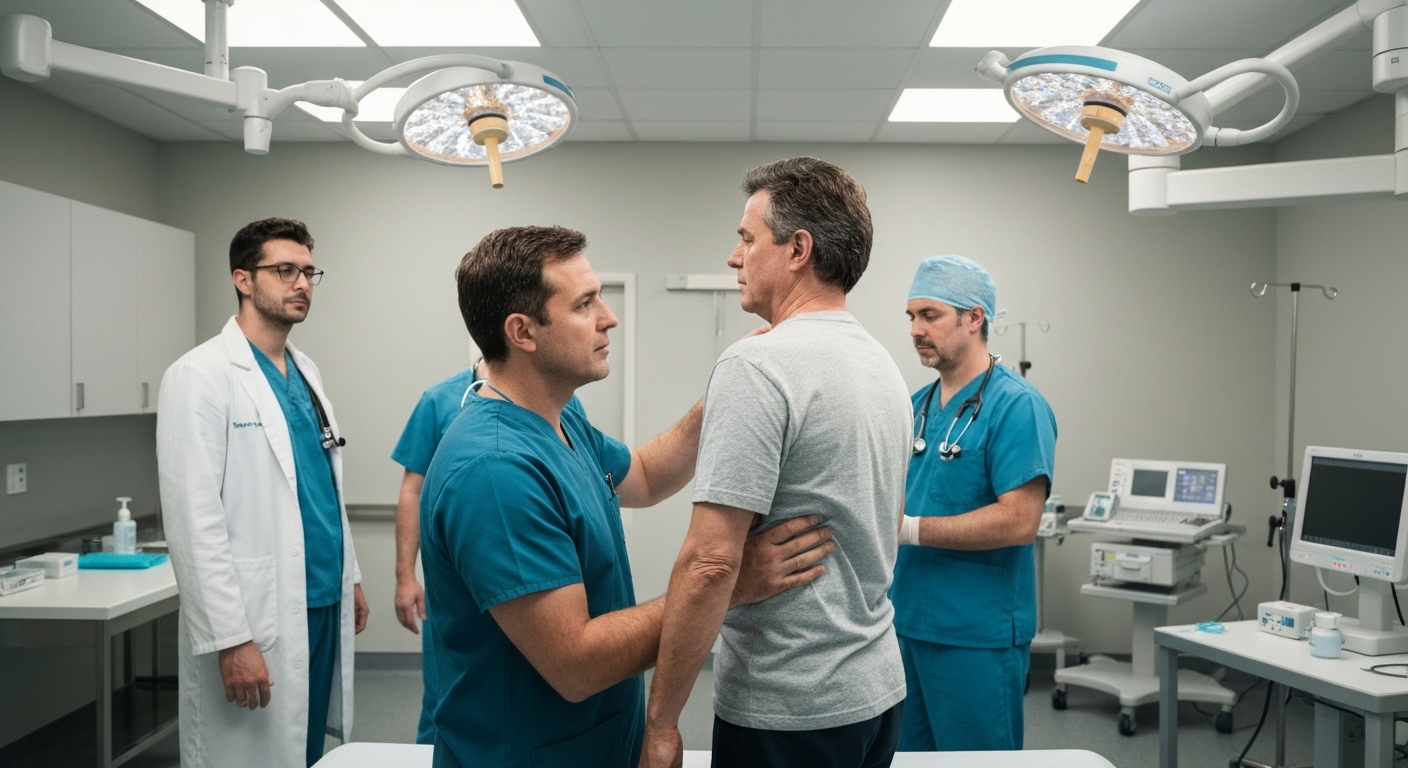
Hip pain is actually a common complaint among scoliosis patients. Understanding the connection between these two conditions is essential for finding effective relief.
The relationship between scoliosis and hip pain isn’t coincidental. When your spine curves abnormally to the left or right, it alters your body’s natural alignment. This changes how weight is distributed across your skeletal structure.
This misalignment forces your hips, pelvis, and surrounding muscles to compensate. The result is often discomfort, stiffness, and pain that can significantly impact your daily activities.
Many patients in the Greater Dallas area who experience hip pain don’t immediately connect it to their spinal condition. They may try traditional hip treatments that provide only temporary relief because the underlying cause—the spinal curvature—remains unaddressed.
That’s why a comprehensive evaluation by a fellowship-trained spine specialist is crucial for accurate diagnosis and effective treatment planning. At Legent Spine, our board-certified surgeons help patients understand the full scope of how scoliosis and hip pain interact. We create personalized treatment approaches that address both the spinal curvature and its secondary effects.
If you’re experiencing persistent hip pain alongside a known or suspected scoliosis diagnosis, expert care can help. You deserve to understand what’s causing your symptoms and what treatment options are available to improve your quality of life.
What Is Scoliosis and How Does It Develop?
may Scoliosis is a three-dimensional deformity of the spine that causes it to curve sideways. It forms a “C” or “S” shape when viewed from the front or back.
While may a healthy spine appears straight when viewed from behind, a scoliotic spine curves to the left or right. It often includes a rotational component as well. may The severity of scoliosis is measured by the Cobb angle—the degree of curvature. Curves greater than are typically classified as scoliosis.
There are several types of scoliosis, each with different causes:
- Idiopathic scoliosis: The most common form, accounting for approximately 80% of cases, with no identifiable cause. It typically develops during adolescence.
- Degenerative scoliosis: Develops in adulthood as spinal discs and joints deteriorate with age, causing the spine to curve over time.
- Congenital scoliosis: Present at birth due to abnormal spinal development in the womb.
- Neuromuscular scoliosis: Results from neurological or muscular conditions that affect spinal support.
For many patients, particularly those with degenerative scoliosis common among Dallas-area adults, the condition progresses gradually. As the spine curves, the body’s center of gravity shifts. This forces compensatory changes throughout the musculoskeletal system. For more information, see our page on scoliosis causes hip painand dallas patients.
The pelvis may tilt, one hip may appear higher than the other, and leg length discrepancies may develop. All of these contribute to altered biomechanics and increased stress on the hip joints.
Understanding what type of scoliosis you have and how advanced it is helps determine the next steps. This knowledge guides whether your hip pain is directly related to your spinal curvature and what treatment approach will be most effective. For more information, see our page on understanding scoliosis hip pain causes symptoms.
The Hip Pain and Scoliosis Connection: Why It Happens
The mechanical relationship between scoliosis and hip pain is complex but understandable. Your spine, pelvis, and hips are deeply interconnected. For more information, see our page on scoliosis hip pain.
Your spine serves as the central support column for your entire body. When it curves abnormally, the effects cascade downward through your kinetic chain.
Several biomechanical factors explain why scoliosis causes hip pain:
Pelvic Obliquity and Misalignment: As the spine curves, the pelvis often tilts to one side to maintain balance. This pelvic tilt means one hip sits higher than the other, creating unequal forces across the hip joints. The lower hip bears more weight and experiences greater stress, while the higher hip must work harder to stabilize your posture.
Altered Weight Distribution: A curved spine doesn’t distribute your body weight evenly. Instead, more pressure concentrates on one side of your pelvis and hip. Over time, this asymmetrical loading can accelerate wear and tear on hip cartilage and contribute to degenerative changes in the joint.
Muscle Imbalances: Your body naturally tries to compensate for spinal curvature by engaging certain muscles more than others. The muscles around your hips—including your hip flexors, gluteal muscles, and hip rotators—may become chronically tight on one side and weak on the other. This imbalance creates abnormal tension and can lead to muscle strain, trigger points, and referred pain in the hip region.
Leg Length Discrepancy: While scoliosis doesn’t actually change your leg bones’ length, the pelvic tilt it causes creates a functional leg length discrepancy. This means one leg effectively operates as if it’s shorter than the other. This alters your gait pattern and places additional stress on the hip, knee, and ankle joints on both sides.
Nerve Irritation: In some cases, the spinal curvature and rotation associated with scoliosis can compress or irritate nerve roots that exit the lower spine. These nerves supply sensation and motor function to the hip region. Irritation can cause hip pain even when the hip joint itself is structurally normal. For more information, see our page on can scoliosis cause hip pain.
Common Symptoms: Recognizing Hip Pain From Scoliosis
Hip pain related to scoliosis often presents differently than hip pain from other causes like arthritis or bursitis. Recognizing these distinctive patterns can help you determine whether your discomfort warrants evaluation by a spine specialist.
Characteristic symptoms of scoliosis-related hip pain include:
- Unilateral pain: Discomfort typically occurs predominantly on one side—often, though not always, on the side where the spine curves inward (the concave side).
- Positional pain: Symptoms that worsen with prolonged sitting or standing, especially when maintaining the same position for extended periods. Many patients notice relief with position changes.
- Diffuse discomfort: Rather than sharp, localized pain, scoliosis-related hip pain often feels like a deep ache or stiffness that extends into the groin, buttocks, or outer hip region.
- Movement limitations: Difficulty with activities that require hip flexibility, such as bending forward, twisting at the waist, climbing stairs, or getting in and out of a car.
- Progressive symptoms: Pain that develops gradually over months or years as your body’s compensatory mechanisms become increasingly strained.
- Treatment-resistant pain: Hip discomfort that doesn’t fully respond to typical treatments like rest, ice, heat, or over-the-counter pain medications—because the root cause lies in the spine, not the hip itself.
If you recognize these patterns in your own experience, it’s worth discussing the possible scoliosis connection with a qualified spine specialist. A comprehensive evaluation can assess both your spinal alignment and your hip symptoms together.
Diagnosis: How Spine Specialists Evaluate the Connection
Determining whether scoliosis is causing or contributing to your hip pain requires a comprehensive evaluation. This examines both your spine and your hips as integrated parts of your musculoskeletal system.
At Legent Spine, Dr. Scott C. Kutz and Dr. Grant Booher use a systematic approach to identify the underlying cause of your symptoms.
The diagnostic process typically includes:
Clinical Examination: Your spine specialist will assess your posture, spinal alignment, pelvic position, and hip range of motion. They’ll look for signs of pelvic obliquity, functional leg length discrepancy, and muscle imbalances that suggest biomechanical compensation for scoliosis.
Imaging Studies: Standing X-rays of your full spine and pelvis reveal the degree of spinal curvature, pelvic tilt, and any secondary effects on hip joint positioning. Advanced imaging like MRI may be ordered if nerve compression or soft tissue injuries are suspected.
Functional Assessment: Observing how you walk, sit, and move helps identify abnormal movement patterns. It reveals the compensatory strategies your body has developed in response to spinal curvature.
Differential Diagnosis: Your physician will also evaluate whether other conditions might be contributing to your hip pain. These include hip arthritis, labral tears, or trochanteric bursitis, which can coexist with scoliosis-related pain.
This thorough evaluation ensures that treatment addresses all contributing factors rather than just masking symptoms.
Treatment Options for Scoliosis-Related Hip Pain
Treatment for hip pain caused by scoliosis must address both the symptoms and the underlying spinal alignment issues. The appropriate approach depends on the severity of your scoliosis, the degree of your hip pain, and how these conditions impact your daily life and overall health.
Conservative Treatment: For many patients, especially those with mild to moderate curvature, non-surgical approaches provide significant relief:
- Physical therapy: Specialized exercises can strengthen weak muscles, stretch tight ones, and improve your body’s ability to compensate for spinal curvature more efficiently.
- Pain management: Anti-inflammatory medications, muscle relaxants, and targeted injections can reduce inflammation and interrupt pain cycles.
- Bracing: In some cases, particularly with progressive curves in younger patients, bracing may help slow curve progression and reduce compensatory stress on the hips.
- Activity modification: Learning proper body mechanics and avoiding positions that exacerbate symptoms can reduce daily hip strain.
Surgical Treatment: When conservative measures don’t provide adequate relief, or when scoliosis is severe and progressive, surgical intervention may be appropriate. Modern minimally invasive techniques can correct spinal alignment, stabilize the spine, and restore more balanced biomechanics throughout your body.
Spinal fusion surgery aims to straighten the spine, correct pelvic obliquity, and eliminate the compensatory forces contributing to hip pain. Many patients experience significant hip pain improvement as their body no longer needs to compensate for severe spinal misalignment.
Recovery times have improved considerably with minimally invasive approaches. These use smaller incisions and preserve more surrounding tissue.
The decision between conservative and surgical treatment is highly individual. It should be made collaboratively with your spine specialist after thorough evaluation and discussion of your goals, lifestyle, and medical considerations.
Scoliosis and Hip Pain in the Dallas Area: Getting Expert Care
Patients throughout the Greater Dallas area have access to world-class spine care without traveling long distances. At Legent Spine, we understand that dealing with chronic hip pain and scoliosis affects every aspect of your life—from work performance to family activities to simple daily tasks. For more information, see our page on katy patients hip pain scoliosis.
Our fellowship-trained, board-certified spine surgeons bring extensive experience in diagnosing and treating complex spinal conditions and their secondary effects throughout the body. We offer comprehensive evaluation that looks beyond isolated symptoms. We strive to understand how your spine, pelvis, and hips work together as an integrated system.
Whether your situation calls for conservative management or surgical intervention, we develop personalized treatment plans. These account for your unique anatomy, symptoms, lifestyle, and treatment goals.
Our dedicated care coordinators guide you through every step of the process, from initial consultation through treatment and recovery. You’ll always know what to expect and have the support you need.
For patients seeking clarity about whether scoliosis is causing their hip pain, we’re here to provide expert answers and effective solutions.
Conclusion: Taking the Next Step
The connection between scoliosis and hip pain is more than just coincidental. It’s a direct biomechanical relationship that stems from how spinal curvature alters your body’s alignment and weight distribution.
When your spine curves abnormally, your hips bear the consequences through unequal loading, compensatory muscle patterns, and altered movement mechanics. Understanding this relationship is the first step toward finding effective relief.
Rather than treating hip pain in isolation, addressing the underlying spinal alignment issues offers the best chance for lasting improvement. Treatment options range from conservative physical therapy and pain management to advanced surgical techniques that can restore more normal spinal alignment and reduce the compensatory stress on your hips.
The key to successful treatment is accurate diagnosis through comprehensive evaluation by a spine specialist who understands these complex interactions. If you’re experiencing persistent hip pain alongside a scoliosis diagnosis—or if you’ve been treating hip pain without success and haven’t considered a spinal connection—professional evaluation can provide clarity and direction.
Relief from scoliosis-related hip pain is achievable with the right expertise and treatment approach. At Legent Spine, our team is committed to helping you understand your condition, exploring all appropriate treatment options, and developing a personalized plan that addresses your specific needs and goals.
We invite you to schedule a consultation to learn more about how addressing your spinal health can improve your hip symptoms and overall quality of life. Don’t let persistent hip pain limit what you can do.
Reach out to our care coordinators to take the first step toward comprehensive evaluation and expert treatment that addresses the full picture of your spinal health.