
Is Spinal Stenosis Behind Your Back or Leg Pain?
Maybe your legs feel heavy halfway through a walk on your favorite Plano trail. Maybe you have to lean on the cart while standing in the grocery checkout line. Symptoms like these often build slowly, and many people write them off as normal aging.
They may point to spinal stenosis. This is a narrowing of the spaces within the spine that can put pressure on the spinal cord or nearby nerve roots.
This guide covers symptoms, causes, diagnosis, and treatment. The reassuring news is that may many people manage spinal stenosis without surgery. For more background, see our overview of spinal stenosis symptoms and treatment.
If your symptoms linger, a comprehensive evaluation with a Legent Spine specialist serving Plano and the Greater Dallas area can help you find answers.
What Is Spinal Stenosis and How Common Is It?
Your spinal canal is a protected channel. It carries the spinal cord and nerve roots from your neck down through your lower back. When that channel, or the small openings where nerves exit, becomes narrower, the nerves can become irritated or compressed.
Stenosis can occur in the neck (cervical spine) or the lower back (lumbar spine). It is less common in the mid-back (thoracic spine). Doctors most often diagnose it in adults over 50, and the lumbar form is the most common.
Some people have stenosis on imaging with few or no symptoms. That is why your symptoms matter as much as your scan.
Spinal Stenosis Symptoms
Symptoms usually develop gradually rather than suddenly, and they may come and go. The location of the narrowing determines which parts of your body are affected.
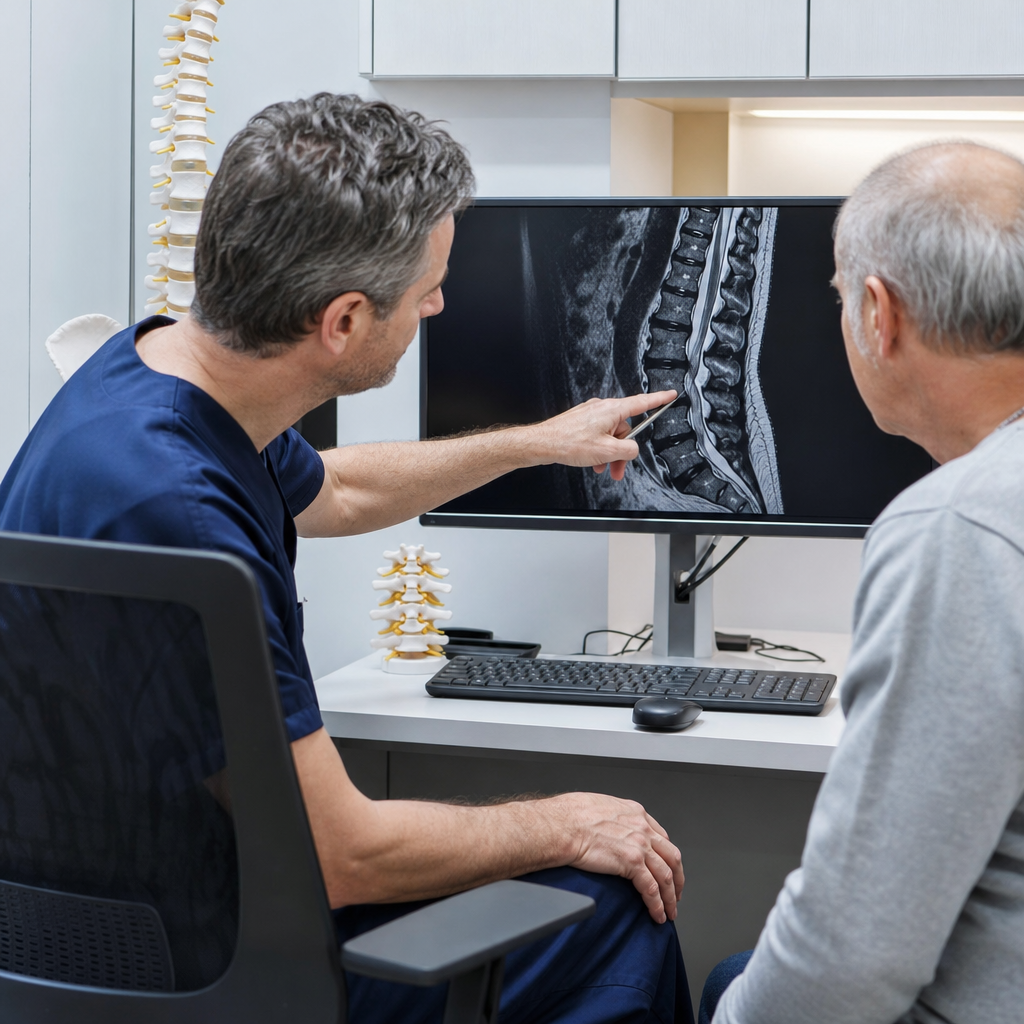
Symptoms of Lumbar Spinal Stenosis
Lower-back stenosis mostly affects the legs, buttocks, and feet. Common signs include:
- Pain, cramping, or heaviness in the legs or buttocks when standing or walking
- Numbness, tingling, or weakness in the legs or feet
- Relief when sitting or leaning forward, such as over a shopping cart
- In more advanced cases, foot drop (a foot that catches or slaps the ground) or balance problems
Doctors call this pattern of leg symptoms neurogenic claudication. It comes from nerve compression in the lumbar spine.
Leaning forward tends to open up space in the spinal canal, which is why bending forward often brings relief.
Symptoms of Cervical Spinal Stenosis
Neck stenosis can be more serious because it may compress the spinal cord itself, not just individual nerve roots. Symptoms can include: For more information, see our page on spinal stenosis symptoms and treatment 3.
- Neck pain or stiffness
- Numbness or tingling in the hands or arms
- Weakness or clumsiness in the hands, such as trouble with buttons or handwriting
- Balance problems or difficulty walking
usually Severe cervical stenosis can lead to myelopathy, a condition in which the spinal cord does not work as it should. Bowel or bladder changes, or rapidly worsening weakness, need prompt medical attention.
What Does Spinal Stenosis Pain Feel Like?
People often describe spinal stenosis pain as burning, aching, or cramping. It can also radiate into the arms or legs.
The pain tends to worsen with standing, walking, or arching the spine backward. A typical muscle strain, by contrast, usually improves with rest and time.
Patients commonly use words like these:
- Burning
- Aching
- Electric or “zinging”
- Cramping
- Heavy or “like wearing ankle weights”
- Numb or pins-and-needles
What Causes Spinal Stenosis?
Most cases result from age-related wear and tear in the spine. A smaller number of people are born with a narrower canal.
Acquired Causes
Over the years, the spine’s joints, discs, and ligaments change. Common contributors include:
- Osteoarthritis and bone spurs: Bone spurs and thickened ligaments can crowd the spinal canal.
- Bulging or herniated discs: Disc material can push into the canal and press on nearby nerves. Our guide on bulging disc symptoms causes and treatment 4 explains this in more detail.
- Spondylolisthesis: One vertebra slips forward over another, which can contribute to lumbar stenosis.
- Other causes: Past spine injuries, tumors, and spinal curvature changes are less common causes. See our article on adult scoliosis symptoms and treatment options 2 for related information.
Congenital Causes
Some people are born with a smaller-than-average spinal canal, which makes symptomatic stenosis more likely. In these cases, symptoms may appear earlier, sometimes in the 30s or 40s. Certain bone conditions can also play a role.
How Spinal Stenosis Is Diagnosed
A thorough, transparent evaluation is the foundation of good care. At Legent Spine, a comprehensive evaluation typically includes:
- Medical history and physical exam: Your specialist checks your strength, reflexes, sensation, and how you walk.
- X-rays: These show alignment and degenerative bone changes, but they cannot directly show nerve compression.
- MRI: MRI is commonly used because it shows the spinal cord, nerve roots, and soft tissues in detail.
- CT or CT myelogram: These are options when MRI is not suitable.
- Nerve studies such as EMG: These can help clarify the source of your symptoms.
Other conditions can look like stenosis. Peripheral artery disease, for example, can cause leg pain with walking that may be mistaken for lumbar stenosis. Peripheral neuropathy can cause similar numbness and tingling. That is why a careful workup matters.
Our dedicated care coordinators help Plano patients with scheduling and imaging, so the process feels manageable. Board-certified specialists such as Dr. Paul Salinas review your findings with you in plain language.
Spinal Stenosis Treatment Options
Treatment depends on your symptom severity, the location of the narrowing, and how much it affects daily life. Many people start with nonsurgical measures before surgery is considered. The goal is personalized treatment, not a one-size-fits-all plan.
Nonsurgical Care
Conservative options Plano patients often try first include:
- Physical therapy and targeted exercise: Strengthening your core and improving flexibility can support the spine and make walking more comfortable.
- Anti-inflammatory medications and activity modification: Medications can ease irritation, and adjusting your activities can help you avoid positions that trigger symptoms.
- Epidural steroid injections: These deliver anti-inflammatory medication near irritated nerves and may offer temporary relief.
- Low-impact activity: Stationary cycling, swimming, and walking with a flexed posture (such as on a treadmill with a slight incline) are often better tolerated than activities that arch the spine. Many Dallas-area fitness centers and community pools offer these options year-round, which helps when summer heat limits outdoor exercise.
When Surgery May Be Considered
Surgery may be worth discussing if symptoms persist despite conservative care. It may also be an option if symptoms significantly limit your daily life or involve progressive weakness or other neurological changes.
The most common approach is decompression, which creates more room for the affected nerves. Depending on your anatomy, a surgeon may also recommend stabilizing the spine with fusion, especially when spondylolisthesis or instability is present.
Where appropriate, minimally invasive techniques use smaller incisions and may support faster recovery. Not every patient is a candidate, and your surgeon will explain the benefits, risks, and realistic expectations. Outcomes vary from person to person.
Take the Next Step Toward Relief
If leg heaviness, arm numbness, or balance changes are getting in the way of the life you want in Plano, you do not have to guess at the cause. A comprehensive evaluation can clarify what is happening and which options fit you best. You can also read more in our guide to spinal stenosis symptoms and treatment 2.
When you are ready, schedule a visit with a Legent Spine specialist. Our fellowship-trained team, including Dr. Grant Booher, and our care coordinators will help you understand your diagnosis and choose a path forward with honest, expert care.